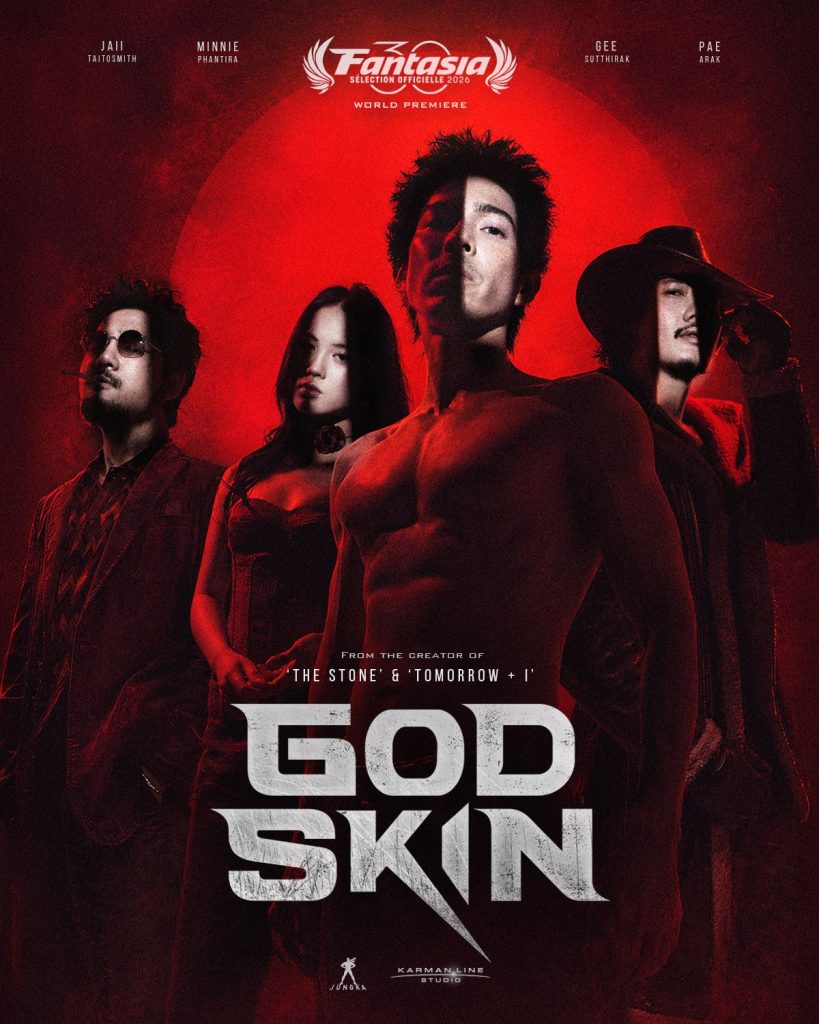

God Skin, directed by Paween Purijitpanya, had its premiere at Fantasia Film Festival 2026, bringing out a social commentary full of colourful action and plot twists.
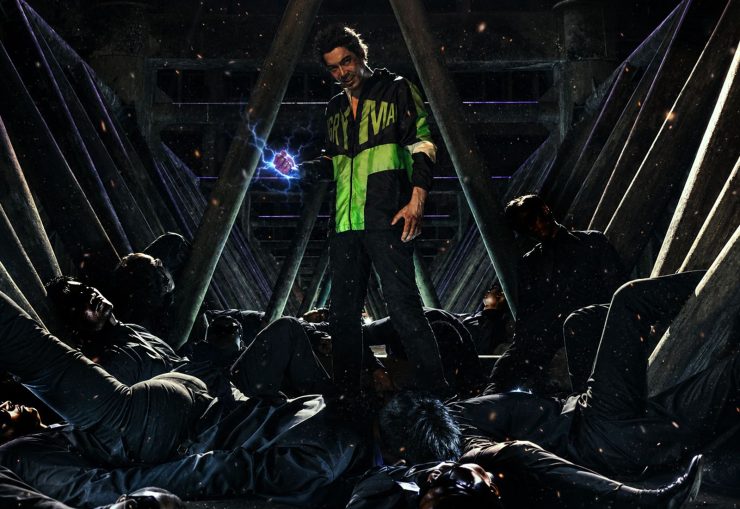
The film follows a delivery driver Win who struggles to pay rent for himself and his sick mother. In a chance encounter, Win meets two of his school acquaintances in one night – a woman named Praewa, who he soon becomes romantically involved with, and Itt, a rich man recruiting fighters to Mirage Stadium. After his mother’s illness progresses, in order to pay the hospital bill, Win reaches out to Itt in hopes of getting into the ring for a single fight. Mirroring the gamblers on the other side of the cage, Win becomes addicted to fighting, largely due to God Skin nanobot tattoos which the fighters are required to get to receive additional strength. This is where the film’s tone is truly revealed, channeling video games of the 90s like Mortal Kombat and Street Fighter, with video game mechanics literally imposed into the film. Other than a health bar and special skills, the fighters (or players) receive power-ups from sponsors outside the cage (yes, just like in The Hunger Games), which is where Win meets his regular sponsor. The character is central for the plot on multiple levels, his behaviour adding up into the presently cinematically ubiquitous “eat the rich” metaphor.

Some close analogues to the film in recent media are Squid Game (2021–2025), The Running Man (2025) and Guns Akimbo (2020). God Skin stands out from the lineup of the movies where the rich make the poor endanger their lives for their entertainment thanks to the impressive fight choreography, inventive visual design and multilayered worldbuilding which, upon the first watch, may leave the viewer scratching their head in confusion. The film’s rewatchability is fueled not only by the engaging action, but mainly by the slow unravelling of Win’s universe (whose name was given to him with purpose) and the multilayered essence of the social commentary in the narrative.