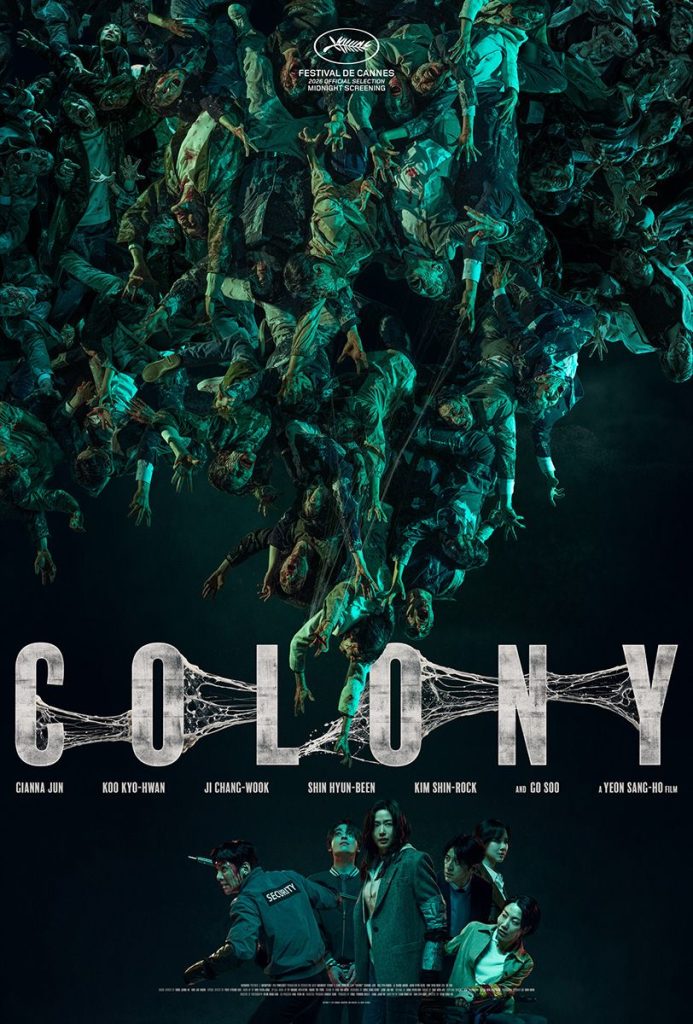


From a zombie horror mastermind Yeon Sang-ho comes Colony (2026) – a new insight into the genre. This time, a new biovirus infection, some traits of which were introduced in the director’s groundbreaking live-action debut Train to Busan (2016), has been evolved into connecting the infected through a hivemind.
In a familiar to Sang-ho fans setting, a group of unlikely allies gets thrown together and tangled into a mission of survival. Se-jeong (Gianna Jun), an ecologist looking for a new career path, finds herself in the middle of the outbreak after attending a conference on a latest discovery in the bioengineering field, where a confrontation between a CEO of a biotech company (Kom Jeong-tae) and his former colleague and disgruntled scientist Seo Young-chul (Koo Hyo-hwan) takes place. The confrontation, stemming from the CEO disagreeing with Young-chul’s version of the ideal world (where the society is connected analogously to the bioengineered mould which is able to communicate with itself), ends with the CEO receiving an injection of the virus, labelling him patient zero.

Following the outbreak, Se-jeong, along with a few other fortunate survivors, must conduct an escape plan, which is redirected when it is uncovered that Young-chul has injected himself with the only vaccine. As the majority of exposition is uncovered from the very beginning, the film gives into action, atmospherically parallelling Romero’s Dawn of the Dead’s (1978) zombie infiltration of a confined space, and Pluribus’s (2025) existential dread of powerlessness in front of a collective consciousness. A conventional action thriller mold is broken by impressive visuals, including dance choreography used as a basis for the contortionistic movements of the infected, which become the most engaging aspect of the repetitive middle act of the film.
Faithful to his previous writing, Sang-ho places character development on the forefront of the narrative. Despite the 123 minutes of brutal zombie and military action, Colony is first and foremost character-driven, introducing archetypal roles for characters who nevertheless feel real and evolve into stronger versions of their original selves, whether they are protagonistic or antagonistic. Every character is flawed, and yet they get an opportunity to redeem themselves by showing certain resilience in the face of a deadly virus. The fate of each character is a direct result of their actions and growth.
Colony is an ambitious sideway step from the director’s previous work, capturing today’s zeitgeist in the forms of military ineffectiveness, technological breakthroughs and moral panic. Above the social commentary, the film is visually effective, lacking only in pacing and overall originality.