

“Success will require resourcefulness and patience.” This line concludes the Gameplay section of the Steam page on Iron Lung. Coincidentally, it may also be applied to the 2026 film adaptation of the same name, independently financed, directed and written by Mark Fischbach, professionally known on YouTube as Markiplier, as the film stretches beyond the comfortable confines of its source material.

A convict, later introducing himself as Simon (Mark Fischbach), is serving a sentence for a crime he allegedly did not commit. His punishment is an expedition – he must pilot a one-man submarine nicknamed the “Iron Lung” to take photographs and, eventually, collect samples of whatever might be hiding at the bottom of an ocean of blood. Thus far, the adaptation is faithful to its source material, diligently recreating the visual setting and the premise of the game. Iron Lung, however, is an immersive first-person indie game with unique yet contained lore, which carries its PS1-style graphics like a badge of honour on its Steam page, proudly announcing: “You can run this”. To successfully turn it into a feature-length film, which maintains the atmosphere of the game while being aimed at audiences possibly unfamiliar with it, requires a fitting cinematic expansion in the form of exposition, pacing, structure and raised stakes.
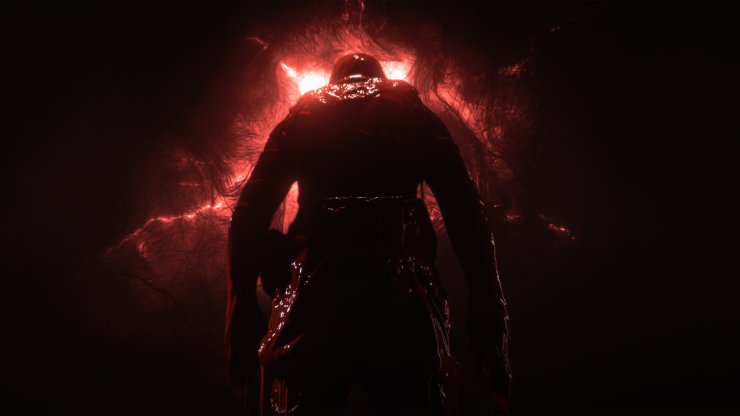
Iron Lung fails to reach a harmony of the elements, instead under- or overindulging in bringing the essence of the game onto the big screen. The movie takes place in a single location, expanding only briefly beyond the submarine, succeeding in evoking a claustrophobic feeling through the inescapable isolation of the main character stuck in a metal container in an ocean of blood. Cinematography and editing, however, fall short in enhancing the feeling even further. The inconsistently unnatural camera angles numerously display Simon in a high angle wide (as much as the setting allows it) shot, omitting the opportunity to maintain discomfort through extreme close-ups. The story nevertheless is moderately successfully translated onto the screen, providing exposition by adding unique characters to create dialogue and expand on Simon’s backstory. Similar to the game, the film begins with an opening scroll delivering vital world-building information. That is where the exposition starts, and it stays overbearing throughout the opening act, attempting to relay as much detail as possible, stretching the film with action that is not gripping or strategic, and simultaneously omitting elements of Simon’s past, which never become revealed. It clashes with the third act as it turns into an incomprehensible Evil Dead-esque bloodbath (but it’s oh so worth it for those visuals). The special effect use is powerful and almost makes the 300000 litres of blood used in the film worth trudging through the prolonged and painfully calculated pacing.
The story of Iron Lung is unique in its bizarre life cycle, beginning with an indie game with barely any lore that takes up 200MB of storage and in just four year expanding into a 127-minute feature film. Despite its flaws, the film accomplishes a lot for the sake of independent cinema, showing the capabilities of low-budget projects developed without studio intervention in reaching wide audiences.